What sensei taught me

When my students forgot their water bottle at home, I gave them mine, because sensei taught me to always put my students first. When my students needed some motivation I told them to do press up, but I was first on the floor, because sensei taught me not to expect anything I wasn’t prepared to do myself. When the lesson finished I thanked my students for coming because sensei taught me to always remember that it was the students who chose me and not the other way around. Before they left my students thanked me back and their eyes were gleaming, because sensei taught me to strive that my lessons were such that I would care to attend myself.

Kids2

Posted in Uncategorized | Leave a comment

Why do katas come in threes?

Buses, as we all know, have an uncanny tendency to come in threes, which is a trait they seem to share with kata. It is difficult to practice karate for any length of time without noticing that katas have sequences of techniques that come in threes. This is such a salient feature of the Heian katas that even a novice karateka will not fail to spot it. However, when sensei recently asked me why I thought katas had repetitions of three, I couldn’t offer him, nor myself, a convincing explanation.

Three buses

Iain Abernethy suggests a plausible explanation, the gist of which is: it is important to practice both sides, but since most people are right handed it is more important to practice the right-hand side. Hence we have the pattern for right-left-right in many katas.

Iain Abernethy

The problem with this explanation is that there is a group of katas that clearly defy the convention. Whilst all three Tekki katas practice both side, they don’t show any preference to either one. Each and every combination is practiced once on one side and once of the other. And the problem isn’t confined just to the Tekki katas. Even within the Heian katas, and in fact most other katas, there are combinations that are only repeated once on either side. For example, in Heian Yondan, the combination kakiwake uke, mae geri, nihon zuki is performed once on the left and then once on the right. Clearly, if it were imperative to practice the right-hand side twice as much we would expect to see this principle applied more uniformly.

Kakiwake uke

Another possible explanation is that repetition is simply a useful learning aid. Again, plausible, but in my view not convincing. Firstly, the very purpose of kata is to facilitate repetition simply by performing the same kata over and over again in pursuit of perfection. Instead of repeating certain sequences, the whole kata could be repeated. Yes, one could argue that within a kata there may be combinations that either warrant or require more repetition, however, the reality is that those sequences that appear in threes tend not to be the most intricate or climatic. Quite contrarily, combinations punctuated by kiai, possibly an indication of their effectiveness, only ever appear once in most katas (again the Tekki katas defy convention with their perfect symmetry). Logic dictates that it is those combination that one would expect to require more practice.

Practice makes perfect

Then why do katas come in threes?

Let’s take a closer look at katas. As I’ve mentioned, some combinations appear once, some twice (usually once on either side) and others of course thrice, but is there some kind of logic behind it?

Fascinating!

I’ll start with the easy bit – combinations that appear twice. This is where I think Iain Abernathy is absolutely correct: katas encourage us to practice combinations on both sides and no other katas do it more conspicuously than the Tekki katas.

Two of each

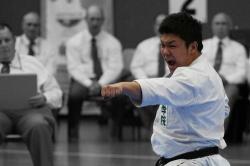
There is also another prominent kata feature that appears twice. Karateka will have also noticed that all katas have two kiais (except Wankan). The two kiais lead me nicely to the next point which is sequences that appear only once, because those sequences that feature a kiai usually appear only once in a most katas. The reason in my view is that it would be impractical bordering on the annoying to kiai more often, let alone repeatedly. A kiai marks a climax point of the kata and using it more liberally would simply dilute its significance and effect.
When in doubt, kiai!

So finally we come to sequences that are repeated thrice. If we examine at those sequences even more closely we can distinguish between two kinds. Short sequences, comprising of single or double techniques, which are repeated three times in immediate succession – and – longer sequences that are repeated first twice and then a third time, with the third repetition often appearing later in the kata and/or with a slight variation.

Examples for the first kind are indeed the three age uke in Heian Shodan or the three teisho uchi in Jion. Those sequences are often performed to a tempo of 1,1-2. An example for the second kind is the combination from Kanku Dai: jodan shuto uchi, mae geri. The latter is also a good example for when the third repetition appears later in the kata and with a slight variation. The first two are followed by  manji uke, gedan nukite, whereas the last repetition is followed by uraken uchi, uchi uke, nihon zuki. Another interesting feature of this kind of repetition is that it is sometimes performed solely on one side (as in thae Kanku katas), which also somewhat contradicts Iain Abernethy’s theory.

The three graces

But what does all this mean? Why repetitions of three?

In my view, the answer is simply aesthetics.

Repetitions of three of the first kind are usually performed going up or down from the starting point (as in Jion) and give the kata embusen roughly the same width and depth and equal proportions mean harmony.

Beyond that, the number three has cultural significance in many societies including the Chinese and the Japanese. From three course meals to three piece suits, from trilogies to triptychs and from the three graces to the trinity – the number three seems to be everywhere including the world of karate. Do I need to mention kihon-kata-kumite?

Kanji 3

In story-telling, repetitions of three are used for emphasis and dramatic effect. The three ghosts of Christmas, the three little piggies, the three witches, the three bears, the three musketeers and on and on the list goes. The greatest story of all, the bible, is replete with examples from the three wise men to the three acts of denial.

Likewise in rhetoric, repetitions of three are a common device. A fine example is Martin Luther King’s famous speech “I have a dream” which ends:

Free at last! Free at last!
Thank God Almighty, we are free at last!

This example echos nicely the element of repetitions in kata whereas the final repetition “we are free at last” is separates from the first two by the words “thank god almighty”. This is similar to kata motifs that appear three times, with the last coming separate from the first two. One example is Empi with the combination: gedan barai, age zuki, otoshi zuki, ushiro gedan barai.

MLK

Does it make sense that what governs the shape of katas is simply aesthetics and not some kind of staragem or practical reason? Of course! Because aesthetic does not mean less practical. We like our homes, cars, phones, meals and pretty much everything to be aesthetic and in many cases aesthetics trump practicality. For kata, as a medium for teaching and practicing, it is important to be aesthetic because if we enjoy what we do we are more likely to do it. If katas were tedious or impossibly intricate, karate would have never become so popular. Having patterns that resonate with our cultural background regardless of who we are means that katas are almost immediately likable. Indeed, it is simply inconceivable that katas would not exhibit those traits that are so ubiquitous in human culture such as symmetry and repetitions of three.

So simply put, katas have repetitions of three because they could not have been created any other way.

And one afterthought – the Tekki katas may not have any sequences of three in them, but there are three of them.

Posted in kata | Tagged , , , , , | Leave a comment

Thoughts on side kicks or “thrust? really?!”

We all know what a yoko geri kekomi is. It is a thrust kick. We equally know that a yoko geri keage is a snap kick. Or are they? In this post I will examine the terminology from three aspects: semantics, karate-jitsu and body mechanics.

BatmanRobin[1]

Semantics

Let’s examine the phrase yoko geri keage first. yoko means side and geri means kick. We all agree on that. We also have some idea that age means rising (e.g. age-uke, age-zuki etc). So, could it be that keage does not actually mean “snap” and instead has something to do with the word age we know from other techniques? Indeed keage (蹴上) is a compound of two Japanese words: keru meaning kick (hence keri/geri), and ageru meaning to raise. So there we have it, keage simply means rising kick. If we consider the trajectory of the kick it make sense – the blade of the striking foot is propelled along an imaginary upwards arc that begins next to the knee of the supporting leg and ends at its intended target.

But hang on a moment! If keage means rising kick, why do we say yoko geri keage? Surely that would mean side rising kick kick. Indeed it does and so the technique should be simply called yoko keage. I can speculate that the misnaming occurred when keage was mistaken to mean simply “snap” and so the word geri was added unnecessarily to create the phrase yoko geri keage as a reverse translation of “side snap kick”.

Now let’s turn our attention to the sister technique, the so called side thrust kick. You have probably already guessed that it should be called yoko kekomi and  you probably have a good inkling that kekomi (蹴込) or rather komi does not really mean thrust. Well, it doesn’t. The Japanese word komu means to take something into or go into and is used to describe many judo waza in the sense that the technique goes into the opponent. I suppose that kekomi could be described in English as “into kick” or “penetrating kick”, however that is no more and no less intuitive than “thrust kick”. Again, if we consider the trajectory of the kick then the heel of the striking foot is propelled along the most direct line into the target, thus “into kick”.

Karate Jitso

Let’s leave the side kicks for a moment and consider the mae geri, which is also considered a type of snap kick. The reasons that are often cited to explain why  the kick should be snapped back after impact are usually: a. to prevent the leg from being trapped by the opponents, and b. to enable the karateka to strike repeatedly. Of course the reasoning is sound, but surely this should apply to all kicks. There is no reason to think that a kekomi is less likely to be trapped than a mae geri or indeed a keage. Similarly, a single kekomi may not be sufficient, so quickly retracting the striking leg to facilitate further attacks is equally logical. Conversely, all kicks, including mae geri and keage, require an element of hip thrust, which is the main power component in the techniques.

Another consideration is the use of kekomi in sparring. Failing to snap the technique can only result in either failing to score (weak impact is made with a fully extended leg) or committing a foul (following through with the technique and striking past). When kicking kekomi or ushiro geri in kumite impact must be made with the knee still retaining a good degree of bend and the foot should be snapped back as soon as contact is made.

As we can see, all keri waza include an element of both snap and thrust, so clearly those terms are not entirely adequate to describe the side kicks specifically. In his blog, sensei Andre Bertel describes keage as a whipping kick and kekomi as a driving kick. He also explains why kekomi should be snapped back and suggests an explanation as to the origin of what he calls “the posed kekomi“.

Body mechanics

In his blog entry, sensei Betrel points to the joint action to differentiate between keage and kekomi. I think that this is key to understanding how the techniques are deployed and indeed this principle should be generalised to cover all keri waza and even te waza.

Our limbs, legs and arms, have two main joints: a ball and socket joint (shoulder/hip) and a hinge joint (elbow/knee). Generally speaking, in all basic karate waza the limb joints are first flexed and then extended rapidly to deliver the blow (when punching the shoulder is first extended then flexed, but that is not a material difference for this argument).

We can thus separate the techniques into two different classes depending on how the joints are used. In mae geri, keage, mawashi geri and uraken uchi first the ball and socket joint is rotated sharply and only once the hinge joint is in position pointing at the target it is then rapidly extended to deliver the strike (this is the “whipping” action sensei Bertel refers to). In tsuki, shuto uchi, kekomi and ushiro geri both joints are extended simultaneously (this is similarly the “driving” action). Again, strictly speaking when delivering a punch from hikite the shoulder is actually flexed, but the main point is that it happens simultaneously to the elbow being extended.

Once we look at the techniques in this light we can come to some interesting conclusions:
1. Punches are always snapped. Since the mechanics of kekomi and ushiru geri are essentially the same, those techniques should be snapped too.
2. The main reason why it is crucially important to snap “whipping” techniques such as uraken uchi is the danger of hyper-extending the hinge joint (elbow/knee). This is true not just when sparring but also in kihon and kata. Failing to do so can lead over time to seriously damaging the joints involved. Note that some hyper-extension can also occur when executing “driving” techniques, albeit to a lesser extent, but still snapping those techniques is similarly important (even if you remain unconvinced by previous arguments).
3. When kicking mae geri or keage the knee needs to rise only until it is pointing at the intended target and then it should be extended to deliver the kick. There is no need to fully raise the knee and doing so will actually either weaken the technique or change it to a “driving” kick. For example, when executing kin geri (a variant of mae geri striking with the instep rather than ball of the foot usually targeting the groin), the kick mechanics are essentially the same as mae geri, but the knee doesn’t need to rise much above the hip.
4. mae fumikomi (sometimes mae kekomi) is to mae geri what kekomi is to kegae. When kicking mae fumikomi or kekomi the knee should first be raised as high as possible and then the whole leg extended.

Conclusion

I hope I’ve convinced you that kekomi isn’t a “thrust” kick and that all karate kicks incorporate elements of both snap and thrust. However, my aim here is not an attempt to change the terminology. I am quite happy to continue using “thrust kick” for kekomi just like we still “dial” telephone numbers although we mostly tap them nowadays. It would not matter one bit if say kegae were called the “wet noodle” kick, so long as the mechanics, purpose and application of those techniques are understood by everyone involved. My sole aim in exploring the meaning of the Japanese terminology is to better elucidate those points for myself and perhaps others.

 Thrust!

Posted in karate misconceptions | Tagged , , , , , , , | Leave a comment

The dojo kun revisited

  • Strive for perfection of character = respect yourself
  • Be faithful and sincere = respect your friends
  • Cultivate the spirit of perseverance  = respect your art
  • Be respectful and courteous = respect others
  • Refrain from violent behaviour = respect society

dojokun

Posted in karate concepts | Tagged | Leave a comment